 English
中文


Why do we need to test urine when checking thyroid?
When going to the hospital to check the thyroid, many people have the same doubt: I clearly feel discomfort in my neck and suspect hyperthyroidism or hypothyroidism, I can understand why the doctor orders blood tests for thyroid function and a thyroid ultrasound, but why do I also need to leave a urine sample for testing? Is there a connection between thyroid diseases and urine? Let's clarify the underlying logic today. Whether you are a woman preparing for pregnancy, a pregnant woman, or someone with thyroid nodules, you won't have any more doubts after reading this.
1. The thyroid gland relies entirely on one key element for its function: iodine. The thyroid gland is a unique "iodine storage organ" in the human body, where more than 90% of the iodine in the body is concentrated, used to synthesize thyroid hormones that control human metabolism, brain development in children, and endocrine stability. Our daily sources of iodine supplementation are quite limited: iodized salt, kelp, laver, and seafood. The iodine ingested into the body has two pathways: 1. It remains in the thyroid gland to produce hormones; 2. All excess and unused iodine is filtered by the kidneys and excreted from the body in the urine. In a nutshell: The iodine content in urine directly reflects your recent total iodine intake. Blood tests can only show the instantaneous thyroid hormone levels in the blood, while color Doppler ultrasound can only show the size of the thyroid, nodules, and enlargement; however, neither can reveal whether you have been consuming too much or too little iodine in your daily diet. Urine iodine testing fills this gap. Second, four groups of people must undergo urine iodine testing for thyroid examination: 1. Women who are preparing to conceive, are pregnant, or are breastfeeding (top priority). The fetus does not have its own thyroid gland, and the development of the brain and nervous system relies entirely on maternal thyroid hormones. Iodine deficiency during pregnancy: Impairs fetal intellectual development and increases the risk of developmental delays; Iodine excess during pregnancy: Induces maternal goiter and exacerbates Hashimoto's thyroiditis. Blood tests for thyroid function can only determine whether the current hormone levels are normal, while urine iodine testing can accurately assess whether daily iodine supplementation meets the standard. Doctors rely on urine iodine values to adjust diets and avoid maternal-fetal iodine nutritional imbalances from the source.
2. Hashimoto's thyroiditis, hyperthyroidism, and hypothyroidism patients Many thyroid disease patients blindly avoid seafood or excessively supplement iodine, causing their indicators to become more chaotic. Through urine iodine testing, one can intuitively judge: low urine iodine: insufficient daily iodine intake, requiring moderate increase in iodized salt and seafood; excessive urine iodine: long-term excessive iodine intake, necessitating a strict low-iodine diet. Instead of relying on feelings to avoid certain foods, relying on numerical science to control iodine intake makes thyroid function indicators more stable.
3. For individuals with thyroid nodules, long-term iodine deficiency or excess can stimulate thyroid hyperplasia, inducing and exacerbating nodules. Color Doppler ultrasound can only reveal the size of the nodules but cannot determine the cause; regular urine iodine testing can assist doctors in determining whether nodules are related to iodine nutritional imbalance, formulating personalized dietary plans, and reducing the risk of nodule progression.
4. For the general population undergoing routine thyroid screening, iodine deficiency disorders and high iodine-induced thyroid damage are key public health monitoring priorities. Disease control and prevention centers, as well as maternal and child health institutions, have uniformly incorporated urinary iodine testing into thyroid screening packages to assess the overall iodine nutrition status of the population in the entire region.
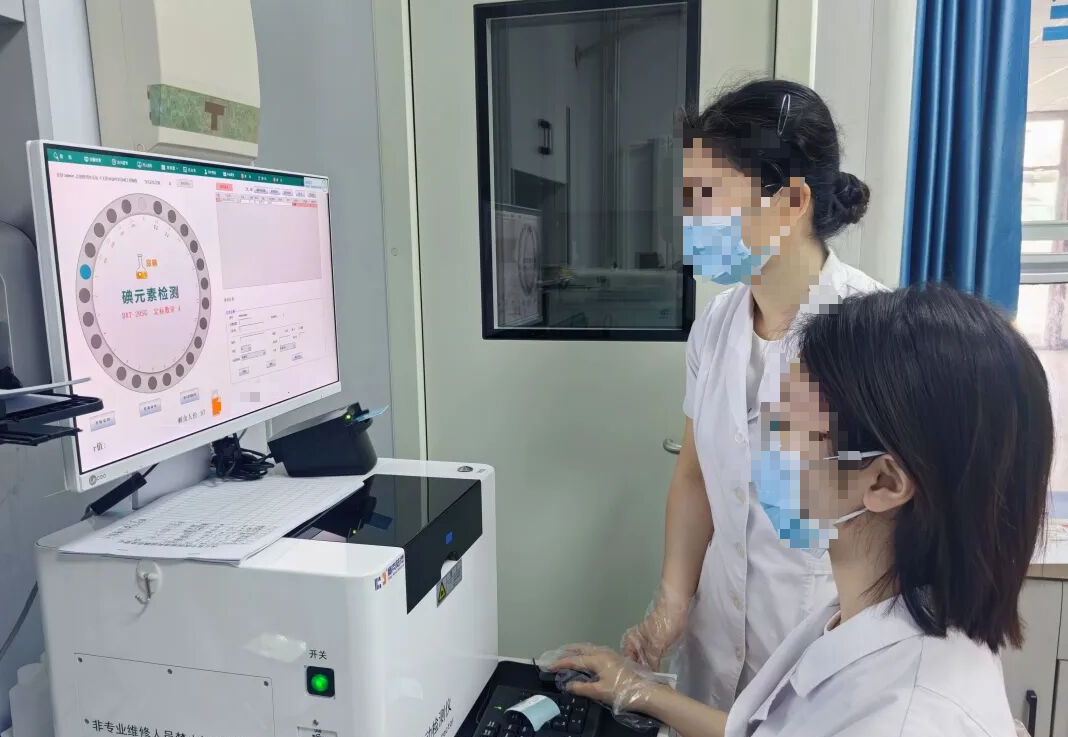
Currently, maternity and child health care hospitals, disease control centers, and physical examination centers widely use fully automated integrated iodine detection equipment (Silky-Road urine iodine detector). The detection data conforms to national industry standards, with accurate and stable results. It is efficient for both single and batch testing, and is suitable for both grassroots screening and individual physical examinations.
Related recommendation
- 1.CMEF2020,Skrd unveiled second-generation products.
- 2.Skrd participates in 2021CACLP with second-generation products
- 3. Silky-Road Medical national clinical Laboratory Quality Assessment report in 2020 was 100% approved
- 4. Silky-Road Medical won the title of "High-tech Enterprise"
- 5.Skrd attended the 2020 CACLP exhibition and presented with patented products
- 6.Skrd attended the 2021 CMEF exhibition and presented with Iodine detection products
- 7.The importance of iodine for pregnant women
- 8.Skrd invite you to participate in the 18th China Association of Clinical Laboratory Practice Expo
- 9.Pregnancy Prepare for Urinary Iodine Test to Have a Healthy Smart Baby
- 10.How to choose automatic iodine detector?
- 11.Pregnant women are the key population for urinary iodine testing
- 12.Silky-Road Medical's 2019 China Clinical Laboratory Quality Evaluation Report was 100% passed
- 13. Silky-Road Medical's first national clinical Laboratory Quality Assessment report in 2020 was 100% approved
- 14.Skrd Medical's products have obtained the CE Conformity Certificate
- 15.Scientific Iodine Supplementation for Smarter Life
- 16.The neccessery of urinay iodine detection
- 17.Your hair loss may cause by iodine thyroid function
- 18.how to choose blood iodine test or urinary iodine test
- 19.Prevention and treatment Iodine deficiency
- 20.Sliky-road intelligemt automatic urinary iodine